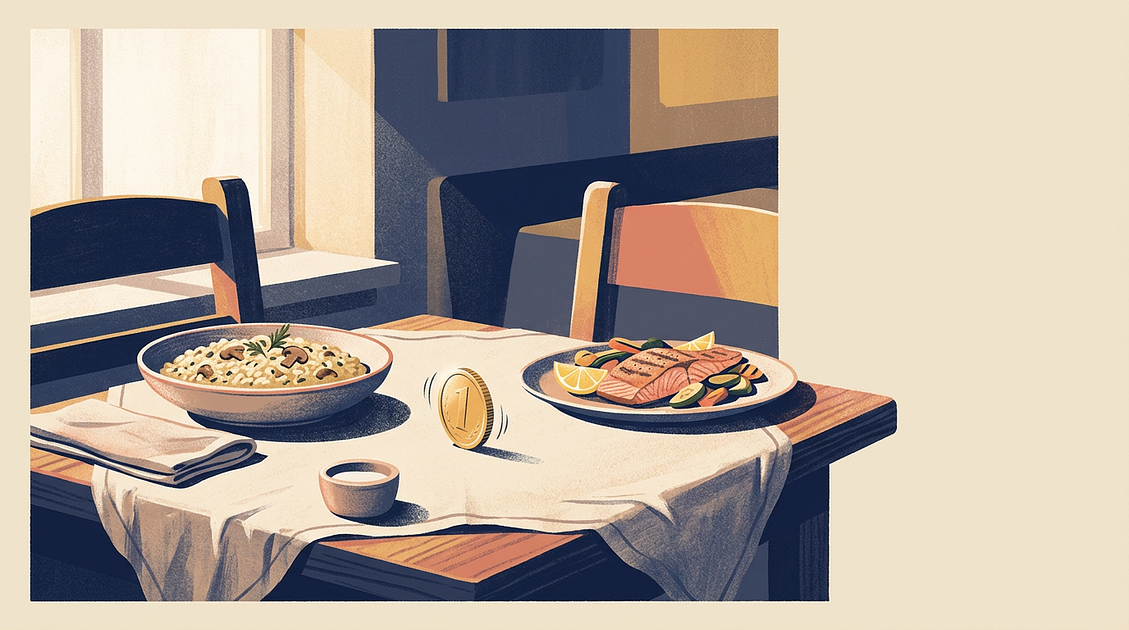
A coin toss is a strange way to make a decision. It has no information about the options in front of you, yet people still use one when they’ve been going back and forth for too long.
You see the result and feel pleased, disappointed or immediately tempted to ignore it. That reaction can seem to tell you something about what you wanted.
Researchers have used exactly that moment to ask a slightly harder question: does the coin simply expose a preference that was already there, or can the suggestion itself change how we respond to the choice?
What the Coin Changes
In 2019, psychologists Mariela Jaffé, Leonie Reutner and Rainer Greifeneder asked people to make a series of choices between dishes for an imaginary five-course meal.
Everyone saw a random result. The important difference was what they were told to do with it. Some participants were asked to treat the coin as a suggestion, while others saw the same toss but were told to ignore it. Nobody had to follow the result.
People who treated the toss as a suggestion reported stronger reactions to what came up. They were more likely to feel approval or disapproval, satisfaction or dissatisfaction, rather than simply being indifferent to the result.
A second experiment used a die instead and found something similar. Participants who received the random suggestion were more likely to report a sudden feeling of knowing what they wanted.
The researchers proposed that a suggestion may make one option easier to picture. If the coin points to the risotto, for example, you briefly imagine ending up with the risotto rather than continuing to compare two names on a menu. That could make an existing positive or negative reaction easier to notice.
It is a plausible explanation, but the experiments didn’t establish that this mental imagery was what caused the stronger feelings. The study also had a visual difference between conditions that could have directed more attention towards the suggested option.
So the useful finding is narrower: giving a random result the status of a suggestion changed how strongly people reacted to it.

Does That Reaction Mean Anything?
Feeling strongly about a result is one thing. Knowing whether that feeling corresponds to something you actually preferred is another.
Jaffé and Greifeneder tackled that problem in later research using art prints. Participants first rated how attractive they found a set of pictures. Weeks later, they returned and chose between pairs of prints that they had rated similarly.
That earlier session gave the researchers something useful. Instead of asking people after a coin toss what they thought they had preferred beforehand, they already had a record.
When the coin pointed to the print someone had previously rated more highly, their reaction to the result tended to be more positive. When it pointed towards the lower-rated print, the reaction tended to be less positive.
That suggests the response to the coin wasn’t simply enthusiasm for whichever option happened to appear.
But there was an important limit. Using the coin did not reliably make people choose the print that matched their earlier ratings more often than people who made the choice without it.
Their feelings contained information about an earlier preference. That didn’t automatically turn those feelings into a better final choice.
And even “better” needs some care here. The researchers could compare a later decision with a rating someone had given weeks earlier. They couldn’t establish which picture that person ought to prefer. There is no objectively correct print to hang on your wall.
A Decision With a Better Answer
That problem changes if one option genuinely performs better than another.
In 2022, Jaffé and Greifeneder tested 542 people using an adapted version of the Iowa Gambling Task. Participants made repeated choices between alternatives that produced different patterns of gains and losses. Over time, experience could reveal which options were more advantageous.
This gave the researchers something the art experiment couldn’t provide: a way of judging the quality of a choice using its outcomes rather than somebody’s previous preference.
Some participants received random coin-flip suggestions before choosing. Those suggestions contained no information about which option would perform better.
Yet under certain experimental conditions, the people using the coin became more likely to choose the advantageous option by the end of 40 trials. Their choices also improved more sharply as the task progressed.
After those 40 trials, they reported being more certain about their decisions and finding the task easier.
That sounds more impressive than the earlier studies, but it also creates a tempting leap. The 2019 research found stronger feelings. The 2022 experiment sometimes found better learning. It would be convenient to say the first caused the second.
The studies don’t show that.
The authors themselves describe several possible ways a random suggestion could affect the decision process. The coin might change how an option is represented, where attention goes or how people use the feedback that follows. The experiment wasn’t designed to settle which mechanism produced the improvement.
There is another reason to be careful. The better choices were not found consistently across every condition.
What a Coin Can’t Do
The Iowa Gambling Task also has one advantage that most difficult decisions don’t: repetition.
Participants could make a choice, see what happened and try again. Over many rounds they had a chance to learn which alternatives tended to work out better.
Choosing between two jobs doesn’t work like that. Neither does deciding whether to move city, end a relationship or spend a large amount of money. You don’t normally get forty comparable attempts with feedback after each one.
And despite the word gambling in the name of the task, the study is not evidence that adding random decisions to casino play improves your chances. The coin contained no information about future outcomes. What mattered was what people did with the feedback they received afterwards.
That may also be why the result is difficult to carry into everyday decisions. Most of them don’t give us forty attempts to find out whether we were learning anything.
A coin toss might make a reaction easier to notice. The awkward part is that, outside the laboratory, we usually have to decide what that reaction is worth.
References
- Jaffé, M. E., Reutner, L., & Greifeneder, R. (2019). Catalyzing decisions: How a coin flip strengthens affective reactions. PLOS ONE, 14(8), e0220736. DOI: 10.1371/journal.pone.0220736.
- Jaffé, M. E., & Greifeneder, R. (2021). This outcome feels right! Subjective evaluations of coin flip outcomes reflect previously stated preferences. PLOS ONE, 16(7), e0253751. DOI: 10.1371/journal.pone.0253751.
- Jaffé, M. E., & Greifeneder, R. (2022). Deciding advantageously after flipping a coin. Acta Psychologica, 223, 103511. DOI: 10.1016/j.actpsy.2022.103511.