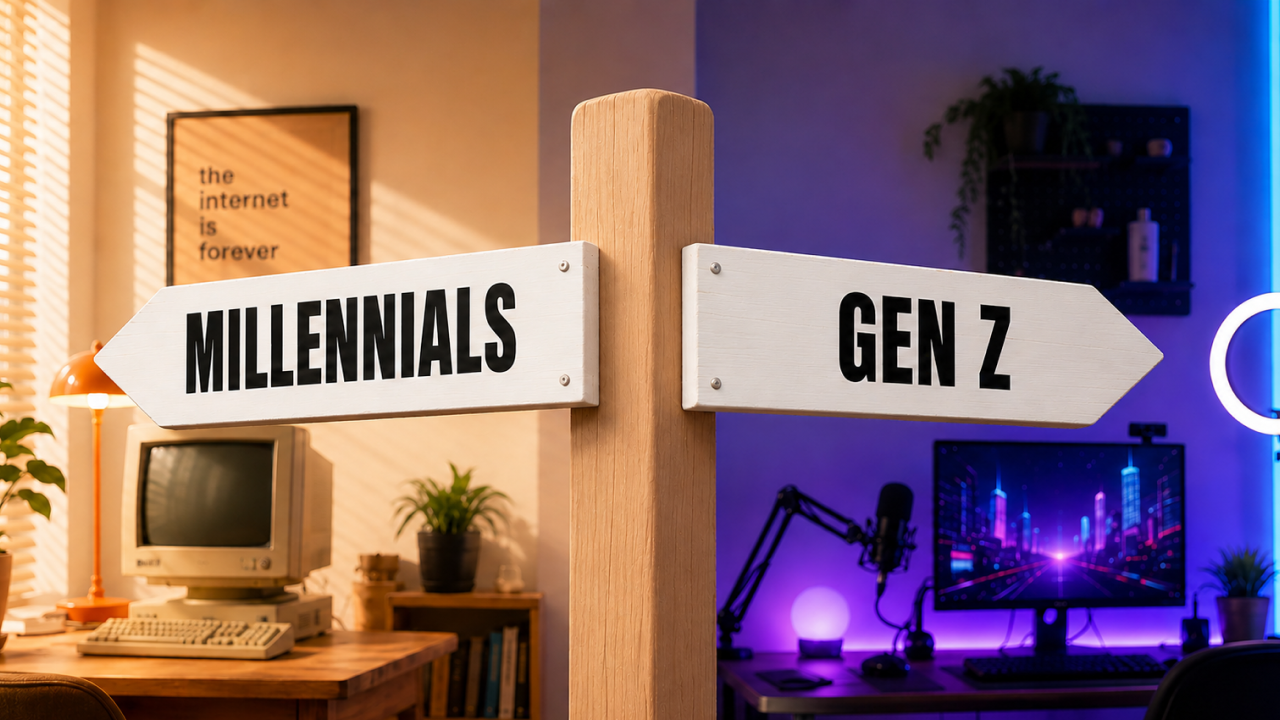
Millennials learned to explore an open web. Gen Z learned to navigate algorithm-driven platforms and the difference may be reshaping how we find information, make decisions and understand the world online.
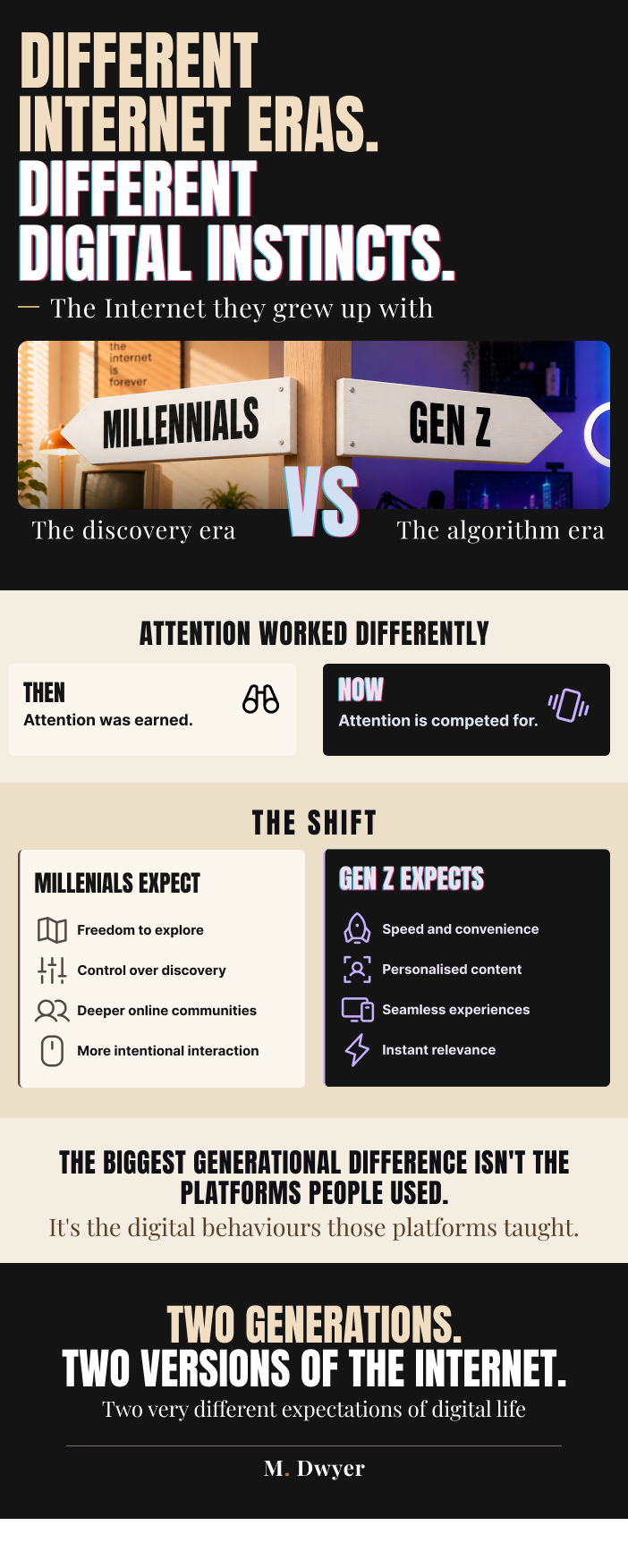
The internet Millennials grew up with and the one Gen Z inherited are not the same medium. They share a name, but not much else. Millennials, defined by Pew Research Center as those born between 1981 and 1996, came of age alongside the consumer web, encountering it as a destination they chose to visit. Gen Z, born between 1997 and 2012, has never known a world without it. That single difference, arriving at the internet versus being raised inside it as an environment, shapes almost everything about how the two groups behave online.
The scale of each cohort makes the distinction worth taking seriously. There are roughly 72 million Millennials and around 69 million members of Gen Z in the United States. Globally, Gen Z has surpassed 2 billion people, making it the largest generation in human history. As of the early 2020s, both generations together account for the bulk of the world's daily internet activity, yet their formative digital experiences could hardly be more different.
What "Exploring" Looked Like
For Millennials, getting online was something of an occasion. Most remember the screech of a 56k dial-up modem, the AOL "You've Got Mail" greeting, and the household rule that the phone and the internet couldn't run at the same time. In 2000, only around half of American adults used the internet at all, and broadband was still a rarity. Pew found that just 3% of U.S. households had a high-speed connection that year. The web was something you visited, logged off from, and came back to later.
Because the early web had no dominant gatekeeper, Millennials learned largely by exploring. They typed URLs from magazines, followed hyperlinks down unpredictable paths, maintained bookmark folders, and built personal pages on GeoCities, Angelfire, and later MySpace. Search itself was a skill worth developing: before Google's PageRank algorithm reshaped the field after its 1998 launch, users juggled competing engines like AltaVista, Lycos, Ask Jeeves, and Yahoo's human-curated directory. Finding useful information meant crafting queries carefully, evaluating sources, and tolerating dead ends. The web rewarded curiosity and patience. It was, in a fairly literal sense, a frontier to be mapped.
What "Navigating" Looks Like
Gen Z encountered a fundamentally finished product. The first iPhone launched in 2007 and the App Store opened in 2008, meaning the oldest Gen Zers were barely entering their teens when the smartphone became the default way to reach the internet. For most of this generation, the internet is not somewhere you go. It is the ambient layer of daily life, accessed dozens of times a day from a device that almost never leaves arm's reach. Surveys from Common Sense Media report that U.S. teens average roughly seven to eight-and-a-half hours of screen media per day, the majority of it mobile.
Crucially, Gen Z grew up inside curated, algorithmically governed environments rather than the open web. Instead of exploring a sprawl of independent sites, they navigate a handful of dominant platforms, YouTube, Instagram, TikTok, Snapchat, whose recommendation engines decide what appears next. Where a Millennial searched, a Gen Zer is increasingly served. Google executives have publicly acknowledged that a large share of younger users now begin product and place searches inside TikTok or Instagram rather than a traditional search box, or Google Maps. Navigation, for this generation, means fluently moving through app interfaces, swiping through feeds, and trusting an algorithm to surface what matters. It is a skill of efficient consumption rather than open discovery, which is worth keeping in mind when thinking about how this cohort interacts with any information system, gambling platforms included.
The Digital Literacy Paradox
There is a tempting assumption that the generation raised on smartphones is automatically the most capable online. Research complicates that "digital native" framing fairly quickly. Stanford History Education Group studies found that students who are fluent at using apps often struggle to evaluate the credibility of online information, for example distinguishing sponsored content from news, or tracing a claim back to its original source. Comfort with an interface is not the same as understanding how the underlying systems actually work.
The contrast is worth sitting with. Millennials, having grown up troubleshooting dial-up connections, installing software, and managing files, tend to carry a stronger mental model of what is happening beneath the screen. Gen Z, raised on sealed and intuitive devices where complexity is hidden by design, is often more fluent at using technology but less familiar with what runs behind it. Educators increasingly distinguish between being "tech-savvy" (smooth at operating apps) and being "tech-literate" (understanding data, privacy, sources, and systems). That gap has quietly reshaped how digital citizenship is now taught.
Why the Distinction Still Matters
These differing instincts carry real consequences. They shape how each generation shops, learns, votes, and forms opinions: A Millennial may open multiple browser tabs and cross-reference reviews, while a Gen Zer may watch a 30-second video verdict and move on. That behavioural gap influences how brands market, how educators design lessons, and how platforms compete for attention. And as artificial intelligence tools like ChatGPT shift the experience yet again, moving from navigating results to receiving a single synthesised answer, a third pattern is already emerging for the youngest users. Which suggests the explore-versus-navigate divide is not a fixed endpoint. It is one frame in a much longer story about how each generation meets the technology of its time.