
There's a version of every significant decision you've made that you never actually made. It exists somewhere just behind your current life, and it has one very convenient quality: nothing ever went wrong in it.
Not because the other choice would necessarily have turned out better, but because you can only imagine it now, after seeing what happened with the choice you actually made. The problems you know about belong to the life you lived. The other one is still hypothetical, which makes it much easier to imagine without problems of its own.
Take a fairly ordinary version of this. You chose the stable job instead of joining a startup. Three years later you're bored, underpaid, and wondering whether you played it too safe. The other life starts to look remarkably good. You imagine the title you might have grown into, the equity that might have vested, the work that might have mattered more.
What tends to disappear from the picture are the problems that alternative would have had to survive. A difficult manager, a funding round that never arrived, a project that went nowhere, or something else you couldn't possibly have anticipated. Whatever version you imagine can now be built around the problems you actually encountered, because those are the problems you know to avoid.
You didn't design the alternative around its possible failures. You designed it around your real ones. That's what makes the comparison so uneven: one path had to happen, while the other only has to be imagined.

The Person Who Chose Didn't Know What You Know Now
Think about an important decision made under genuine uncertainty: accepting a job, moving somewhere new, staying in a relationship, leaving one. At the time, you didn't know how things would turn out. You had some information, some expectations, and plenty of things you could only guess at. That's what a decision under uncertainty actually is.
Once you know the outcome, however, it becomes remarkably difficult to remember how uncertain it originally felt.
Baruch Fischhoff demonstrated this in his classic experiments on hindsight bias. He gave people descriptions of historical events and asked them to judge how likely several possible outcomes had been. Some participants were also told which outcome had actually occurred. Knowing the result pushed their estimates towards that outcome, making it seem more predictable in retrospect. People were also largely unaware of how much that knowledge had affected their judgement [1].
In other words, once we know how something ended, it's difficult to return mentally to the uncertainty that existed before it happened. The clues that mattered can suddenly look more obvious, while possibilities that went nowhere become easier to overlook.
That changes the question how could I not have seen this? in an interesting way. The person asking it knows which warning signs eventually mattered. The person who had to make the decision didn't.
The Mind Doesn't Replay the Past. It Edits It.
Regret doesn't require us to reconstruct every detail of the path we didn't take. The mind tends to be more selective than that.
Neal Roese's review of counterfactual thinking found that these thoughts are particularly likely to be activated by negative experiences and tend to target causes that seem relevant to what went wrong [2]. So when we imagine how things could have been different, we don't necessarily rebuild the whole situation. We change particular pieces of it.
Suppose a move to another city went badly because you struggled to build a social life. Looking back, your counterfactual might become I should have stayed. If the main problem was financial, the imagined correction might instead become I should have negotiated harder or taken the other offer. What happened helps determine which part of the past now looks like the part that should have changed.
Regret, then, isn't necessarily replaying the decision. It's using the outcome to decide which part of the decision deserves editing.
Some Roads Are Easier to Romanticise Than Others
Regret also seems to care about what kind of thing we mentally change.
Zeelenberg and colleagues explored this by asking people to recall regretful or disappointing experiences and then imagine undoing them. People thinking about regret were more likely to change something they themselves had done, while people thinking about disappointment were more likely to change something about the situation. Further experiments produced the same basic distinction: changing a person's actions generated more regret, while changing external circumstances generated more disappointment [3].
That helps explain why regret can feel so personal. It doesn't simply imagine a nicer world. It often imagines a different version of you acting inside it.
There is another pattern that makes the roads not taken particularly interesting. Gilovich and Medvec's work on the timing of regret found that actions tend to feature more prominently in short-term regret, while inactions become more prominent over longer periods [4]. The things we didn't do, the risks we didn't take, the conversations we never had, can stay with us differently from decisions whose consequences we actually experienced.
That matters because actions leave evidence behind. If you took the job, dated the person or moved to another city, you know at least something about what followed. The experience accumulated ordinary days as well as important ones: difficult colleagues, unexpected bills, bad timing, compromises and bits of luck you could never have predicted beforehand.
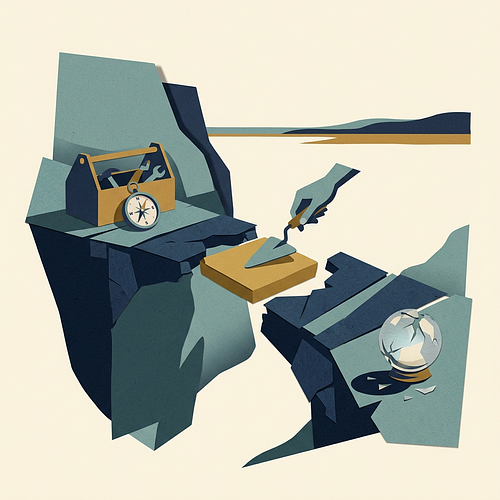
An inaction leaves much more empty space. You don't know what would have happened if you'd moved to Berlin, taken the other offer, asked the person out or started the business, because none of those possibilities ever had to become an ordinary life. That gives the mind considerably more freedom when reconstructing them later. The road you took has consequences you can remember; the road you didn't take still has possibilities you can imagine.
Sometimes We Rewrite the Past in the Opposite Direction
There is an important complication, though. We don't always use hindsight to make the unchosen alternative look better. Sometimes, particularly after disappointment, we seem to do almost the opposite and revise the past in a way that makes the better outcome look less attainable than it originally did.
Tykocinski, Pick and Kedmi called this retroactive pessimism [5]. In one study, football supporters estimated their team's chances before and after an important match. After their team lost, supporters revised those estimates so that winning now seemed less likely than it had before the result was known. In two further experiments involving the loss of a stipend, participants facing the more disappointing loss gave lower estimates of the probability that things could have turned out better.
This complicates the idea that hindsight simply beautifies the road not taken. Sometimes we look back and think we obviously should have chosen differently; at other times, disappointment seems to push us towards deciding that the better alternative probably wasn't very attainable anyway.
Hindsight doesn't always make the alternative more attractive. Sometimes it helps make the alternative disappear.
When "If Only" Is Actually Useful
None of this means counterfactual thinking is a mistake. In fact, imagining what we could have done differently can be useful precisely because it gives us a way to learn from what happened.
Epstude and Roese reviewed a broad body of research showing that counterfactual thinking can contribute to behaviour regulation and performance improvement [6]. One route is quite direct: a disappointing result prompts a thought about what could have been done differently, which can then influence what someone intends to do next. In one experiment discussed in their review, students who had experienced a disappointing academic result were asked to generate ways their performance could have been better. Afterwards, they reported stronger intentions to engage in behaviours that could improve future performance.
The value of if only therefore isn't necessarily in reconstructing the past accurately. Sometimes it's in producing a useful next move.
Suppose you ignored repeated signs that a client was unreliable and the project eventually collapsed. Thinking I should have taken those signals more seriously may identify something you can genuinely change. The information existed, and when similar evidence appears again, you can respond differently.
Compare that with I should have known the market would crash six months later. It sounds superficially similar because both thoughts imagine a better decision, but the second one doesn't identify anything you could realistically have done with the information available. It asks the earlier version of you to know the future.
That gives regret a more useful test than simply asking whether you can imagine a better outcome: does the thought give your future self something they could actually do differently?
A Bad Outcome Doesn't Automatically Mean a Bad Decision
Even when we aren't explicitly imagining another life, knowing how things turned out can change how we judge the decision that came before.
Baron and Hershey demonstrated this across five studies on what became known as outcome bias [7]. Participants were given decisions made by other people under uncertainty, involving medical choices or monetary gambles, and were told the outcomes. Importantly, they were told that they had the same relevant information the original decision-maker had possessed. Even so, favourable outcomes led people to rate the reasoning more positively, see the decision-maker as more competent, or show greater willingness to trust that person's judgement. Unfavourable outcomes pushed those evaluations in the opposite direction.
The outcome had changed people's judgement of the decision even though the information available when that decision was made had not.
That's an important distinction because good decisions can end badly and poor decisions can occasionally work out. Once we know the result, however, luck and judgement become surprisingly easy to confuse.
So a better question for an old decision isn't simply did this work out? It's was this reasonable given what I knew, what I could reasonably predict, and the alternatives available at the time? Those are different standards. One judges the result. The other judges the decision.
The Road Not Taken Never Had to Survive Reality
There is something slightly strange about asking whether the other life would have been better, because the question sounds more answerable than it really is.
You know what happened after the decision you made. You don't know what would have happened after the other one. You can simulate it, sometimes intelligently and sometimes usefully, but eventually the evidence runs out and imagination takes over.
That doesn't make regret irrational. There may have been signs you ignored, information you misunderstood, or risks you should have taken more seriously. Those are worth finding because they can change what you do next.
But there is a difference between finding a mistake and inventing a certainty. I should have paid more attention to what I knew is a lesson. I should have known what was going to happen asks something impossible of the person who made the decision.
Maybe that's the uncomfortable thing about roads not taken. We can spend years comparing our real life with them, but they never become evidence. They remain possibilities.
The life you chose had to find out what happened next. The other one never did.
References
- Fischhoff, B. (1975). Hindsight ≠ foresight: The effect of outcome knowledge on judgment under uncertainty. Journal of Experimental Psychology: Human Perception and Performance, 1(3), 288–299. Source
- Roese, N. J. (1997). Counterfactual thinking. Psychological Bulletin, 121(1), 133–148. Source
- Zeelenberg, M., van Dijk, W. W., van der Pligt, J., Manstead, A. S. R., van Empelen, P., & Reinderman, D. (1998). Emotional reactions to the outcomes of decisions: The role of counterfactual thought in the experience of regret and disappointment. Organizational Behavior and Human Decision Processes, 75(2), 117–141. Source
- Gilovich, T., & Medvec, V. H. (1994). The temporal pattern to the experience of regret. Journal of Personality and Social Psychology, 67(3), 357–365. Source
- Tykocinski, O. E., Pick, D., & Kedmi, D. (2002). Retroactive pessimism: A different kind of hindsight bias. European Journal of Social Psychology, 32(4), 577–588. Source
- Epstude, K., & Roese, N. J. (2008). The functional theory of counterfactual thinking. Personality and Social Psychology Review, 12(2), 168–192. Source
- Baron, J., & Hershey, J. C. (1988). Outcome bias in decision evaluation. Journal of Personality and Social Psychology, 54(4), 569–579. Source