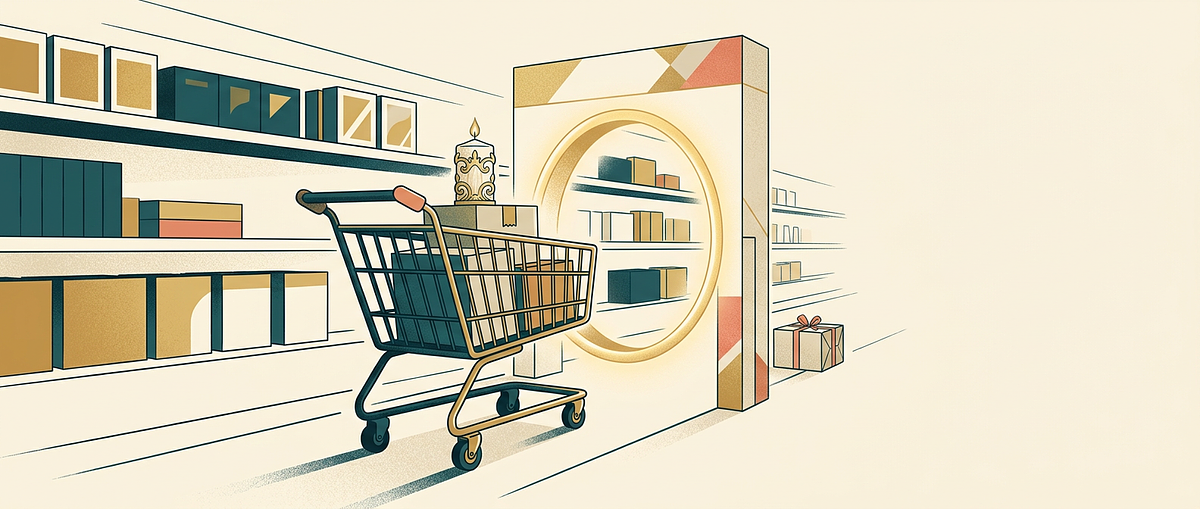
You're eight dollars away from free shipping.
Your shopping cart contains $42 worth of things you actually came to buy. Delivery costs $8, unless you spend $50, in which case it costs nothing. So you keep browsing. You find a $12 candle, add it to your order, and feel rather pleased with yourself.
You've just spent $12 to avoid spending $8.
Of course, you also have a candle now. Perhaps you wanted one anyway, and perhaps getting something useful for an extra four dollars was a perfectly reasonable decision. But there's a good chance you weren't thinking about candles when you started looking. You were thinking about that little message telling you how close you were to getting something for free.
It's a familiar kind of satisfaction, the feeling of having avoided a charge rather than having spent more money. And it raises an interesting question about the way we make decisions.
If we're willing to spend money to get something for free, what exactly are we valuing?
The Last Cent Changes Everything
Most of us understand that free is better than expensive. What's less obvious is why free can feel so much better than almost free.
In 2007, researchers Kristina Shampanier, Nina Mazar and Dan Ariely investigated this distinction through a series of experiments involving chocolate [1].
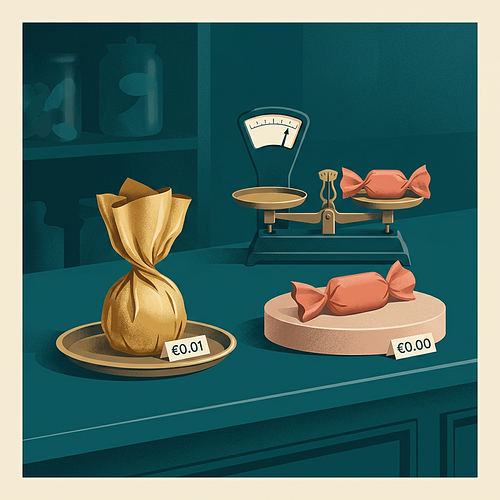
In one version, participants could choose between a premium Lindt truffle for 15 cents and a Hershey's Kiss for one cent. The Lindt chocolate was generally considered the more desirable product, and many participants were willing to pay the difference.
Then the researchers reduced both prices by one cent.
The Lindt truffle now cost 14 cents, while the Hershey's Kiss was free.
Economically, the difference between the two options hadn't changed. The premium chocolate still cost 14 cents more than the cheaper one. Yet the choices shifted dramatically towards the Hershey's Kiss.
The researchers called this the zero-price effect. Their experiments suggested that reaching zero can produce a disproportionate increase in an option's attractiveness, beyond what we would expect from an ordinary price reduction.
One explanation they investigated was emotional. Getting something for nothing can generate a positive feeling that becomes part of the appeal of the offer itself. We're no longer evaluating only the product and its price. We're also responding to the pleasure of getting a deal that appears to involve no sacrifice.
The experiments involved inexpensive products and relatively straightforward choices, so they don't establish how people respond to more consequential offers. But they do suggest that zero occupies a special place in how we evaluate an opportunity.
The Purchase You Weren't Planning to Make
Free shipping introduces a complication that the chocolate experiment didn't have. The product may be free to deliver, but reaching that point can require another purchase.
Researchers Michael Lewis, Vishal Singh and Scott Fay examined how shipping charges affected purchasing behaviour using data from an online retailer [2]. They found that shipping fees influenced both the likelihood of placing an order and the size of customers' baskets. Free-shipping promotions, including those tied to a minimum order value, could generate additional sales.
The threshold matters because it changes the calculation. Below $50, delivery costs $8. Above $50, that charge disappears. Rather than gradually decreasing as you approach the target, the shipping fee drops suddenly when you cross it.
For someone whose cart already contains $48 worth of products, adding a genuinely useful $3 item might be a sensible choice. They spend $51 instead of $56 and receive something extra.
But not every additional purchase offers that kind of value. Sometimes the item we add is something we wouldn't have considered buying without the promotion.
Without the promotion, we might choose between paying for delivery and abandoning the purchase. With it, we may start searching for something else to buy, even when we hadn't planned to spend another dollar.
When Free Makes Us Think Twice
Imagine discovering that a museum is offering free admission for one afternoon.
It's somewhere you've wanted to visit, and under normal circumstances you'd pay a modest entrance fee. But the free event is likely to attract a crowd. You might spend an hour travelling there, another hour queuing, and much of the afternoon navigating packed galleries.
Suddenly, the offer doesn't sound quite so appealing. You might even prefer to pay a small amount and visit on a quieter day.
In 2022, Xiaomeng Fan, Fengyan Cindy Cai and Galen Bodenhausen published research investigating circumstances in which free offers become less attractive than offers with a small positive price [3].
Across five studies, they found that zero pricing could increase demand when the additional costs of obtaining or using something were low. But when those costs were high, the effect could reverse.
Their explanation was particularly interesting. A zero price could produce positive emotions while simultaneously encouraging people to examine the other costs involved. When those costs were substantial, the increased scrutiny could outweigh the pleasure of getting something for free.
This complicates the familiar idea that we're helplessly attracted to anything with a zero price tag. The same feature that makes an offer appealing can also prompt us to wonder what we're missing.
A free sample offered at the supermarket feels effortless to accept. A free holiday that requires attending a three-hour sales presentation feels rather less generous.
The word hasn't changed. What has changed is everything surrounding it.
An hour spent queuing is easy to imagine. A condition expressed as a multiplier, a restriction or a withdrawal limit can be much harder to picture, particularly when the number that first catches our attention is the promised benefit.
The Price That Isn't on the Label
Consider a casino promotion offering 20 free spins.
At first glance, the benefit seems straightforward. You can play a slot game without paying for those particular spins. If they produce winnings, you might imagine you've received something of value without having risked your own money.
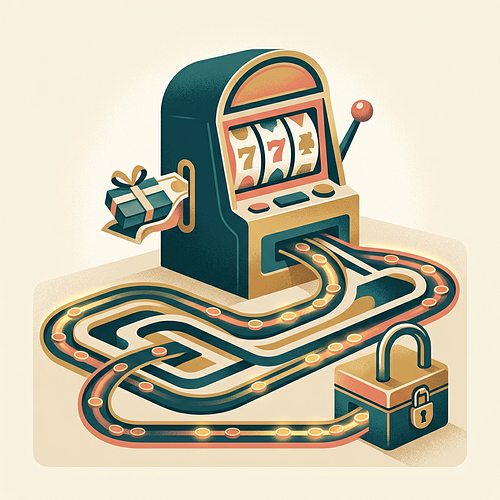
But suppose the winnings are credited as bonus funds, subject to a wagering requirement before they can be withdrawn.
One part of the offer is immediately understandable: 20 spins at no initial cost. The other requires you to work out what happens to any winnings, which games qualify, how much betting is required and whether a maximum withdrawal applies.
Other promotions introduce different commitments. A no-deposit bonus may require no initial payment but still restrict withdrawals, while a deposit-matched bonus requires players to contribute their own money before receiving additional funds. The precise conditions vary between offers, and a free benefit isn't necessarily equivalent to immediately withdrawable cash.
A wagering requirement specifies how much must be staked on qualifying games before bonus funds or associated winnings become eligible for withdrawal. It refers to cumulative bets, not an amount that will automatically be lost.
Someone might knowingly accept those conditions. Someone else might misunderstand them. And a third person might decide that the potential benefit simply isn't worth the effort.
The question is whether understanding the conditions changes how attractive the offer feels in the first place.
What Happens When We Understand the Offer?
In a 2026 study published in the Journal of Gambling Studies, Jamie Torrance and colleagues recruited 585 UK bettors to investigate how people understood financial gambling incentives [4].
Participants were randomly assigned to see a welcome bonus either with or without a worked example explaining its wagering requirement.
The promotion offered a 150% bonus on a deposit. Someone depositing £50 would receive £75 in bonus funds, but a wagering requirement of 10 times the bonus meant they would need to place £750 in qualifying bets before any bonus winnings could be withdrawn.
Among participants who saw the offer without the example, 92.4% underestimated the amount they would need to wager.
The researchers also asked how attractive participants found the promotion. On a six-point scale, its average rating was 3.75 without the worked example and 2.39 when the calculation was shown.
The bonus and its conditions were identical in both cases. Yet participants who could see the calculation clearly found the offer considerably less appealing on average.
The reduction in attractiveness was smaller among participants reporting greater gambling severity, suggesting that clearer information doesn't necessarily influence everyone's decisions in the same way.
This isn't evidence that the zero-price effect caused the initial attraction. Instead, it shows how understanding the conditions of a promotion can change its perceived value.
Other research adds context. The Behavioural Insights Team has examined difficulties understanding wagering requirements, particularly when they apply to both deposits and bonus funds [5]. Research commissioned by the UK Gambling Commission found that free spins and free bets were among the most frequently received and used promotions. Some participants saw them as low-risk opportunities, while others described gambling outside their usual patterns in response to promotional offers [6].
The appeal of a promotion can therefore involve several different influences: the attraction of a free benefit, the desire to avoid risking personal money and the difficulty of understanding what accepting an offer actually involves. These mechanisms need not operate together, and they won't affect everyone equally.
From the outside, however, someone who has carefully evaluated an offer may behave exactly like someone who has misunderstood it.
The Price of Free
You went online to buy $42 worth of things. A few minutes later, you were searching for something you hadn't wanted until buying it meant getting something else for free.
Perhaps that's the strangest thing about free. Sometimes the offer doesn't just change what we're willing to pay. It changes what we find ourselves wanting.
References
[1] Shampanier, K., Mazar, N., & Ariely, D. (2007). Zero as a Special Price: The True Value of Free Products. Marketing Science, 26(6), 742–757.
[2] Lewis, M., Singh, V., & Fay, S. (2006). An Empirical Study of the Impact of Nonlinear Shipping and Handling Fees on Purchase Incidence and Expenditure Decisions. Marketing Science, 25(1), 51–64.
[3] Fan, X., Cai, F. C., & Bodenhausen, G. V. (2022). The Boomerang Effect of Zero Pricing: When and Why a Zero Price Is Less Effective Than a Low Price for Enhancing Consumer Demand. Journal of the Academy of Marketing Science, 50, 521–537.
[4] Torrance, J., Wright, S., Newall, P., Crawford, T., Quigley, M., & Dymond, S. (2026). (Mis)Comprehension and (Mistaken) Attractiveness of Financial Gambling Inducements among UK Bettors. Journal of Gambling Studies.
[5] Behavioural Insights Team. Should Wagering Requirements on Gambling Bonus Offers Be Capped?.
[6] UK Gambling Commission. (2023). Exploring Consumer Journeys Using Gambling Promotional Offers and Incentives.