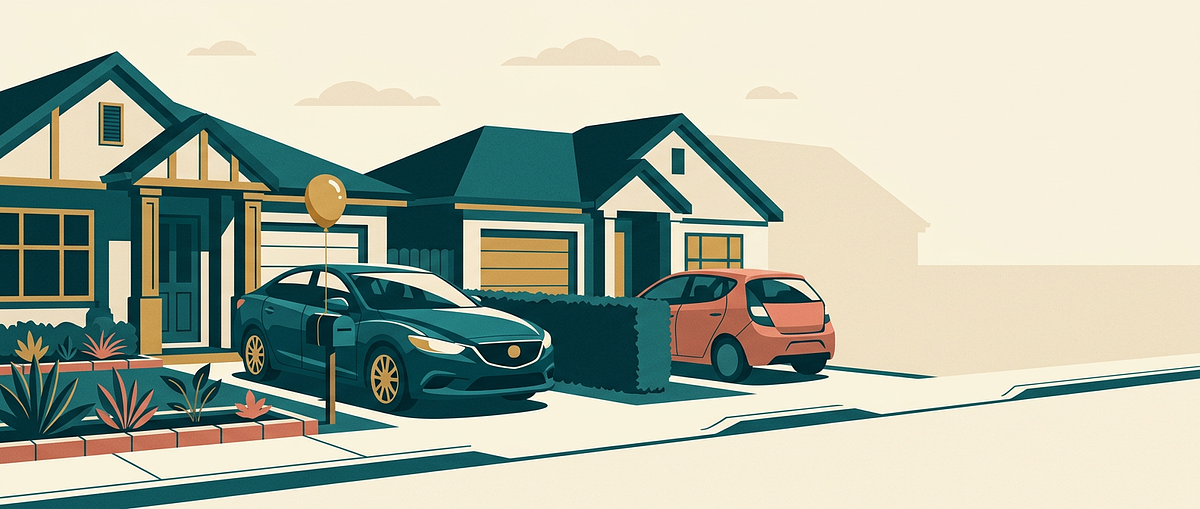
When a neighbour wins the lottery, their finances change and yours stay as they were. Yet you might soon notice a newer car outside their house, or work being done on a property much like yours.
Would any of that affect what you decide to buy?
The Dutch Postcode Lottery gave researchers a way to examine what happened to people who hadn't won anything, even though the money had arrived right next door.
The Neighbours Who Bought Cars
In a study published in 2011, Peter Kuhn and his colleagues examined a lottery in which each winning ticket paid 12,500 euros before tax, with one participating household also receiving a BMW. A typical postcode contained about 19 households, some of whom had bought tickets and some of whom had not. The researchers surveyed residents of winning postcodes and nearby areas that had not won, roughly six months after the draw [1].
The random selection of the postcode made that comparison useful. In an ordinary neighbourhood, it is hard to tell whether spending differs because neighbours influence one another or because they have similar incomes and circumstances. Here the prize had arrived by chance, while the households that had never bought tickets received no money from it.
Among people who had not bought a ticket, those living immediately next door to a winner were more likely to have bought a car in the following six months. One estimate put the increase at close to seven percentage points, roughly seven extra car purchases per hundred comparable households. That is a considerable change for people who had not won anything [1].
The researchers found some evidence of more exterior home renovations too, although that result was less consistent. Cars and exterior renovations are both easy for neighbours to notice, which makes comparison a plausible explanation. But it would be too simple to imagine everyone copying the winner's new BMW. Most people who won the BMW actually converted it into cash [1].
Six months after the draw, the researchers found no detectable drop in happiness among non-winning neighbours. That does not tell us how anyone felt when the prize was announced, or why they later bought a car. It does mean the purchases cannot be treated as a measure of envy [1].
The Neighbours in the Bankruptcy Records
Buying a car tells us little about how someone paid for it, or whether the purchase eventually created financial trouble. The Dutch surveys were not designed to follow those consequences. A separate Canadian study later looked at bankruptcy filings in an entirely different population of lottery neighbours.
Sumit Agarwal, Vyacheslav Mikhed and Barry Scholnick studied lottery wins between 2004 and 2014 in one Canadian province, which they could not name because of a confidentiality agreement. The neighbourhoods were tiny, with a median of 13 households per postal code. They compared places where someone had won relatively large prizes with places where someone had won smaller ones, and followed bankruptcy filings by other residents [2].
Larger prizes were followed by more bankruptcies among non-winning neighbours over the next three years. That does not mean most neighbours of a lottery winner went bankrupt. Filings were uncommon in these small areas; the difference emerged across many neighbourhoods [2].
The researchers could also examine what people owned and owed when they filed. Bankruptcy records from neighbours of larger winners showed higher values for assets such as cars and houses, but not the same pattern for less visible possessions. They also showed more secured debt, borrowing backed by an asset such as a property or vehicle, without a comparable increase in unsecured debt [2].
Those details are consistent with people spending more on things others can see. But the records captured assets and debts at the time of bankruptcy, not a diary of what someone bought after the lottery draw. They cannot establish when those possessions were acquired, or whether trying to match a neighbour had anything to do with it [2].
The Bank Has a Say, Too
Borrowing also depends on what lenders are prepared to offer. The Canadian researchers found higher borrowing in areas around larger lottery wins, particularly among people with stronger credit scores. That pattern was not as clear among people considered more likely to default [2].
Unlike the bankruptcy records, these credit records included the winners as well as their neighbours, so not all the extra borrowing can be attributed to people who missed out. The researchers also could not separate a person's wish to borrow from a lender's willingness to lend. Both help determine how much debt appears in the records [2].
Two households can look equally comfortable from the street, even when buying the same car means something very different for each of them. For one, it might be an easy purchase. For the other, it could mean years of repayments and less room for anything unexpected.
The researchers can't tell us whether these neighbours were trying to keep up with anyone. But their findings make me think differently about what keeping up actually means. We tend to notice when people have the same things. We rarely see what each person may have had to give up to get there.
References
- Kuhn, P., Kooreman, P., Soetevent, A., & Kapteyn, A. (2011). The Effects of Lottery Prizes on Winners and Their Neighbors: Evidence from the Dutch Postcode Lottery. American Economic Review, 101(5), 2226–2247. Author working paper.
- Agarwal, S., Mikhed, V., & Scholnick, B. (2020). Peers' Income and Financial Distress: Evidence from Lottery Winners and Neighboring Bankruptcies. The Review of Financial Studies, 33(1), 433–472. Working paper.