
You've watched both teams all season. You know which striker has been struggling, which manager tends to make questionable substitutions and how the clubs performed the last time they met.
By the time someone asks who you think will win, you probably have an answer. More importantly, you have reasons for it.
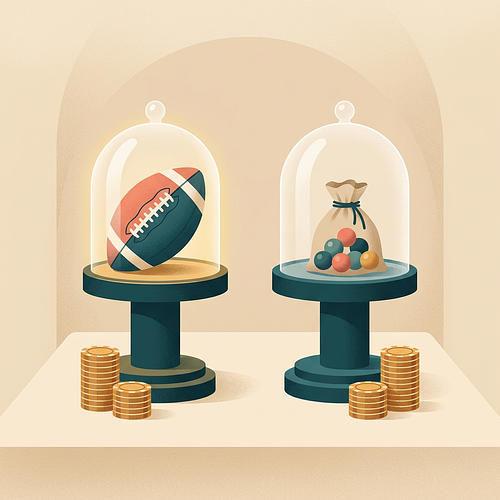
Now imagine someone offering you a bet on that match. Would you feel as comfortable accepting an equivalent gamble involving a coloured ball drawn from a bag?
It's an odd comparison, but one that researchers used to investigate how people judge uncertainty when they recognise the world behind it.
A Football Match and a Bag of Coloured Balls
In a 2025 study published in the Journal of Economic Behavior & Organization, Martin Chegere and his colleagues recruited regular sports bettors in Dar es Salaam, Tanzania, for an experiment involving real money [1].
Some participants received bets on English Premier League matches. Others received lottery tickets involving coloured balls.
The researchers designed the lotteries to offer the same payouts and comparable chances of winning, using bookmakers' estimates of the football outcomes. This allowed them to examine whether the sporting setting itself influenced how people valued the opportunity.
Participants reported how likely they thought they were to win. They were also offered guaranteed money in exchange for their tickets, giving the researchers a way to measure their value.
The results revealed a difference. People holding football bets reported higher chances of winning and valued their tickets more highly than those holding comparable lottery tickets. On average, participants in both groups lost similar amounts of money [1].
The comparison has an important limitation: bookmaker odds provide estimates of sporting probabilities, not certainty about the actual chances of each result. Nevertheless, the difference in participants' judgements gave the researchers something worth investigating.
Perhaps people valued football bets more because they had personally chosen the team.
What If Someone Else Chose Your Bet?
Choosing a football team involves a little ritual of its own. You consider the players, recent performances and whatever else seems relevant before settling on your prediction.
The researchers wanted to know whether that act of choosing explained the higher valuations.
So they tested another condition in which participants received tickets for outcomes selected in advance. They couldn't choose the football result or the lottery colour themselves.
The difference persisted. Those given football tickets still valued them more highly and reported greater confidence in winning [1].
That ruled out personal choice as a necessary explanation, although it didn't identify precisely what caused the difference.
The researchers also investigated whether participants simply enjoyed football betting more than lotteries. Their additional evidence offered limited support for enjoyment as the main explanation.
They considered overconfidence a more plausible interpretation. Participants appeared to place greater faith in their assessments of sporting outcomes than their financial results warranted, although the experiment couldn't establish the precise psychological mechanism [1].
There was still another possibility to investigate. Perhaps people were responding differently because the probabilities behind football odds weren't sufficiently clear.
Would Showing the Numbers Change Anything?
A betting price tells you what a successful wager would pay. It also implies a probability, but that information isn't always immediately obvious.
The researchers tested whether making it more explicit would affect participants' assessments.
Some football bettors were shown the winning probabilities implied by the odds, rather than the odds alone.
The additional information produced no statistically significant change in their reported chances of winning or the amounts they valued their tickets at [1].
This was a limited result, and the researchers acknowledged that the experiment might not have had enough statistical power to detect certain effects. It doesn't establish that presenting probabilities is generally ineffective.
But it adds an interesting detail to the earlier findings. Giving people clearer numerical information didn't produce a detectable shift in how they evaluated their football bets.
The researchers had now tested three possible influences: the sporting context, the act of choosing and the presentation of probabilities. The familiar setting remained relevant even when personal choice was removed, while the numerical intervention showed no clearly detectable effect.
The experiment couldn't establish exactly why. That uncertainty is worth preserving rather than filling it with a neat psychological explanation.

When an Explanation Becomes a Prediction
Following football teaches you to notice things that a casual spectator might miss. A change in formation, an injured defender or a manager's tendency to make substitutions late in the match can all be relevant.
Experience also gives you a remarkable supply of explanations.
If your team wins, you can often identify the decisions that made the difference. If it loses, you can usually explain that too. Football offers enough moving parts for almost every result to make sense once it has happened.
Predicting the result beforehand is a different challenge.
An explanation can identify something genuinely important without telling us how likely it is to determine the outcome. And the more familiar we are with a subject, the easier it becomes to overlook that gap.
The Tanzanian experiment doesn't tell us that experienced bettors lack expertise. Some people may genuinely make better predictions than others. What it shows is that the setting in which an uncertain opportunity appears can influence how people assess it.
The researchers couldn't fully explain why football bets felt more valuable to participants than comparable lotteries. But the difference remained, even when people hadn't chosen the bet themselves.
The odds were comparable, yet people felt more confident about the football bet. It's curious how much more convincing a chance can seem when it involves something we know well.
References
- Chegere, M. J., Falco, P., Nieddu, M. G., Pandolfi, L., & Stein, M. R. (2025). The Magic of the Game: Experimental Evidence on Sports Betting Behavior. Journal of Economic Behavior & Organization, 240, 107301. Published study. Research working paper.