
There's a strange period after something good happens when it still belongs entirely to you. Maybe you got the job you wanted, someone finally said yes, or an email arrived that you'd been waiting weeks for. Whatever happened is already real, and for a little while, nobody else knows enough about it to have an opinion.
Eventually, you tell someone. They might be more excited than you expected, barely react at all, or say something that makes you look at the whole thing slightly differently. None of this should be able to change what happened. The job is still yours, the answer is still yes and the email still says exactly what it said before you showed it to them. And yet the experience may not feel quite the same afterwards.
That creates a peculiar possibility. Someone who had nothing to do with an event may still be able to influence what that event comes to mean to you. So perhaps the interesting question isn't simply why we share good news. It's how somebody else's reaction can change our experience of something that was already over before they even knew about it.
Something Can Matter Before Anyone Else Knows
Before looking at what sharing adds, it helps to establish what it doesn't create. Something good doesn't need an audience to have value, and money gives us an unusually clean way to see the distinction.
Imagine winning €4 million tonight and deciding that nobody can know. The money would still change what is possible. You could clear a mortgage, stop worrying about an unexpected bill or make decisions that previously depended heavily on whether you could afford them. None of those changes requires recognition from anyone else.
Research on lottery wealth gives us good reason not to dismiss that private value as a temporary thrill. Erik Lindqvist, Robert Östling and David Cesarini studied 3,362 Swedish lottery players between five and 22 years after the lottery events they analysed. Because they could compare players within groups where prize amounts were randomly assigned, the researchers had an unusually useful way of isolating the effect of wealth itself. Larger prizes were associated with sustained increases in overall life satisfaction, with financial satisfaction appearing to explain an important part of the effect. The estimated effects on happiness and mental health were smaller, and the researchers found no evidence that the increase in life satisfaction simply disappeared as more time passed after the win [1].
That gives us an important starting point. If nobody ever discovered the €4 million, the win could still matter enormously. The interesting part begins when we ask what becomes possible only after somebody else knows.

Good News Can Keep Changing After It Happens
Psychologists use the term capitalization to describe what happens when people communicate positive events to others. It sounds technical, but the behaviour itself is ordinary. Something good happens, and one of the first things we want to do is tell someone.
Shelly Gable and colleagues examined this process across four studies. They found that communicating positive events was associated with greater daily positive affect and wellbeing beyond the effect of the positive event itself. Those benefits were stronger when people felt that the person receiving their news had responded actively and constructively rather than passively or negatively [2].
That tells us that sharing can add something to a positive experience, but it doesn't yet tell us exactly what has changed. A later series of four experiments and a daily diary study by Harry Reis and colleagues gets closer to that question. Their findings supported two mechanisms: sharing good news could increase the perceived value of the positive event itself, particularly when the other person responded enthusiastically, while enthusiastic responses could also increase trust and positive social orientation towards the person receiving the news [3].
The timing is what makes this particularly interesting. By the time you tell someone, the positive event has already happened, yet the response you receive afterwards may affect how you evaluate it. The other person cannot alter the event itself, but their reaction can become part of what that event comes to mean to you.
A Reaction Adds Something That Wasn't There Before
Imagine finally getting a job you really wanted and telling someone close to you. They become immediately excited, ask questions and start talking about celebrating. Now imagine the same offer followed by a distracted oh, nice before the conversation moves somewhere else.
The job has not changed between those two versions. Neither has the salary, the contract or what you did to earn it. What has changed is the social information now attached to the experience. Before the conversation, you knew how you felt about what happened. Afterwards, you also know something about how another person sees it.
Research involving 79 dating couples suggests that these reactions can matter beyond a momentary boost or disappointment. Shelly Gable, Gian Gonzaga and Amy Strachman asked couples to discuss recent positive and negative events while researchers observed the interactions and participants reported how understood, validated and cared for they felt. Two months later, responses during discussions of positive events were more closely related to relationship wellbeing and whether couples had broken up than responses during discussions of negative events [4].
This complicates the idea that sharing is simply a way of extending a good feeling. When you tell somebody what happened, you are also discovering what the event looks like from outside your own head. Their response can communicate admiration, indifference, excitement, envy or something harder to read, and that information did not exist for you before the conversation took place.
Sharing, then, does more than expose an experience to another person. It introduces a social meaning that wasn't there before.
Now Imagine the News Is €4 Million
A life-changing win makes that mechanism easier to see because it pushes the consequences much further.
If you keep the €4 million private, its financial value remains intact. Once you tell your closest friend, however, the win can become something you celebrate together, something that explains why your plans have suddenly changed and something that can enter the shared history of the relationship.
But there is another change. Your friend now knows something about you that they didn't know yesterday: you have €4 million. That makes this different from many ordinary pieces of good news because the person receiving the information may no longer be entirely outside the event. The change in your circumstances can alter what seems possible between the two of you. A holiday you once couldn't afford, a loan you previously couldn't make, a job you no longer need or even the way you split a restaurant bill can now be interpreted against information that did not exist before.
This doesn't mean wealth inevitably damages relationships, and evidence from lottery winners gives us good reason to avoid that simple story. Joan Costa-Font and Nattavudh Powdthavee examined longitudinal British data and found that larger lottery wins were associated with a greater probability of meeting friends on most days. At the same time, some more instrumental social connections moved in the opposite direction: winners reported less reliance on support networks and less frequent interaction with neighbours. Importantly, the average patterns were largely driven by the relatively small number of people with large wins, suggesting that small and medium prizes may not be enough to substantially alter social ties [5].
The useful insight isn't that sudden wealth makes relationships better or worse. It's that sufficiently consequential good news can change the social environment in which the experience continues to exist. Once another person knows, their reaction is no longer necessarily just a reaction to your happiness. They are responding to information that may also change how they understand their relationship with you.
Privacy Keeps One Variable Out
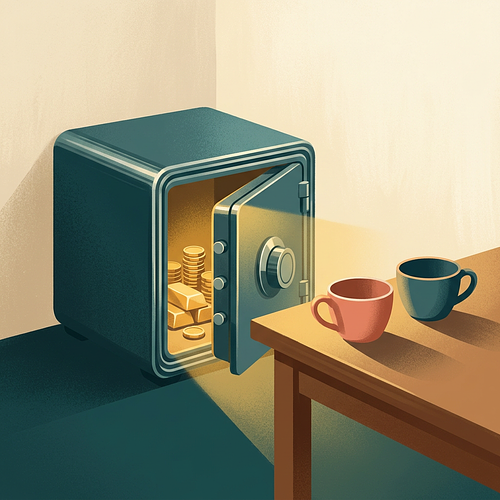
Seen this way, privacy does something more interesting than simply prevent other people from knowing. It preserves a version of the experience before anyone else has interpreted it.
That doesn't automatically make privacy better. The research on capitalization suggests that sharing positive events, particularly with people who respond enthusiastically, can add something genuinely valuable to the experience and to the relationship. Keeping everything private would also mean giving up those possibilities.
But privacy removes a variable. Nobody can be impressed by what happened, minimise it, compare themselves with it or start behaving differently because of it. Whatever the experience means during that period is being constructed without information about how somebody else sees it.
Once you share it, that changes. You haven't handed the experience over to another person, and their opinion doesn't replace your own, but you now know their reaction. That knowledge itself becomes part of the information available when you think about what happened.
So Can Someone Change Something That Already Happened?
Not literally. Nothing in this research suggests that another person can somehow rewrite an event or determine whether it was genuinely good for you. The €4 million remains €4 million. The job offer remains a job offer. Whatever happened before the conversation remains exactly where it was.
What can change is the meaning that develops around it. The evidence on capitalization suggests that sharing a positive event can affect its perceived value, while the response we receive can influence both our experience of the event and our relationship with the person we told. The lottery research adds another layer: when the event changes our circumstances substantially enough, other people knowing about it may also alter the social world in which those circumstances now exist.
That takes us somewhere slightly different from where we started. Good news does not require an audience to become valuable, and another person cannot retroactively change what happened. But an experience doesn't necessarily finish acquiring meaning at the moment it occurs. Some of that meaning can be built afterwards, through the reactions, conversations and relationships that follow it.
Which means telling someone good news is not always just describing an experience that is already complete. Sometimes it is allowing another person's reaction to become part of what that experience means to you.
Maybe some good news is worth sharing. The more interesting question might be who we let become part of it.
References
- [1] Lindqvist, E., Östling, R., & Cesarini, D. (2020). Long-Run Effects of Lottery Wealth on Psychological Well-Being. The Review of Economic Studies, 87(6), 2703–2726. Source
- [2] Gable, S. L., Reis, H. T., Impett, E. A., & Asher, E. R. (2004). What Do You Do When Things Go Right? The Intrapersonal and Interpersonal Benefits of Sharing Positive Events. Journal of Personality and Social Psychology, 87(2), 228–245. Source
- [3] Reis, H. T., Smith, S. M., Carmichael, C. L., Caprariello, P. A., Tsai, F.-F., Rodrigues, A., & Maniaci, M. R. (2010). Are You Happy for Me? How Sharing Positive Events With Others Provides Personal and Interpersonal Benefits. Journal of Personality and Social Psychology, 99(2), 311–329. Source
- [4] Gable, S. L., Gonzaga, G. C., & Strachman, A. (2006). Will You Be There for Me When Things Go Right? Supportive Responses to Positive Event Disclosures. Journal of Personality and Social Psychology, 91(5), 904–917. Source
- [5] Costa-Font, J., & Powdthavee, N. (2023). Does Money Strengthen Our Social Ties? Longitudinal Evidence of Lottery Winners. Rationality and Society, 35(2), 139–166. Source