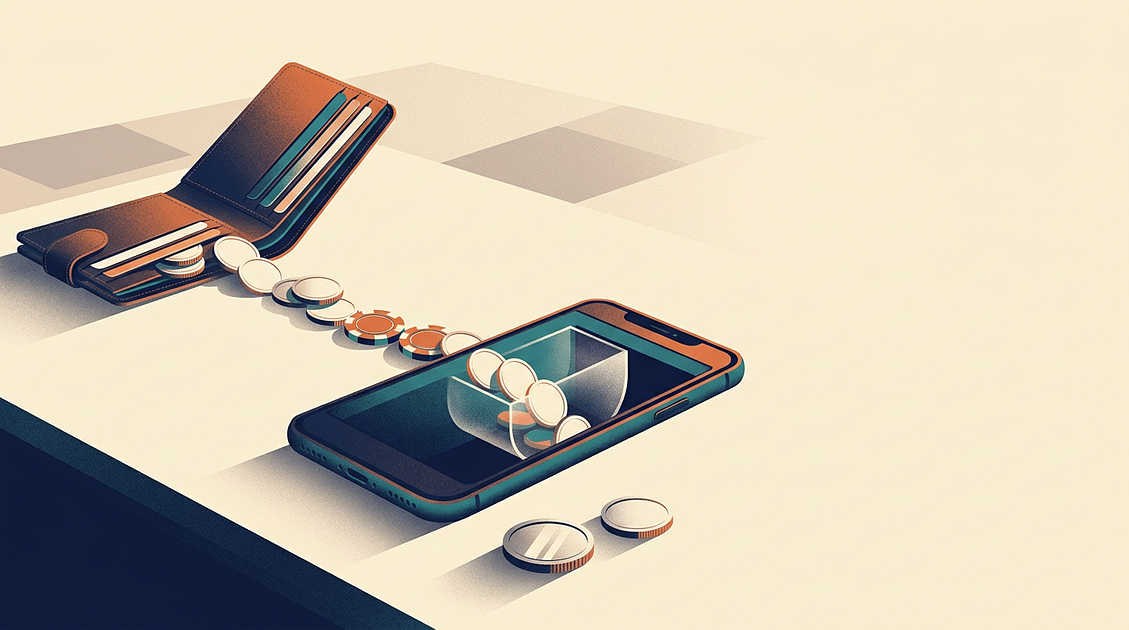
You probably know what a €20 bet is worth. The more interesting question is whether it feels the same when that €20 is already sitting inside an online balance as it would if you had to take a €20 note out of your wallet before every bet.
With cash, the decision and its financial consequence are difficult to separate. If you start with €50 and hand over €20, you're left holding €30. What you spent and what remains arrive as part of the same physical experience.
Online, those moments can be separated. The money may have left your bank account earlier, when you made a deposit. By the time you place the bet, you're interacting with a balance on a screen. The €20 is perfectly visible, but the original act of parting with the money has already happened.
That doesn't mean players forget that digital money is real. There's no reason to assume someone looking at a €20 bet suddenly stops understanding what €20 means. The more interesting possibility is subtler: changing the way money is represented may also change which parts of spending are psychologically present when a decision is made.
And gambling isn't the only place where that question matters. Most of us now spend a large part of our lives paying without physically handing anything over. In the UK, cash accounted for around 60% of payments in 2008. By 2023, it was 12% [1]. If we want to understand what happens to a bet when money becomes a number on a screen, it helps to start with what we've already learned from the much larger shift from cash to cashless spending.
What Cash Makes Difficult to Ignore
Imagine you have €50 in your wallet. You spend €12 on one thing and €18 on another. You don't need a separate system to tell you that you have €20 left. The money still in your hand or wallet does that for you.
A card or phone can separate those two pieces of information. The €18 is perfectly visible. Your remaining balance may be one tap away in a banking app, but the payment itself doesn't require you to look at it.
Behavioural researchers have long been interested in something called the pain of paying: the negative feeling that can accompany parting with money. Drazen Prelec and George Loewenstein argued that this discomfort can play a role in consumer self-regulation because paying makes the cost of consumption psychologically present [2].
Cash makes that cost particularly tangible. You count it, hand it over and physically possess less afterwards.
There is even some exploratory neurological evidence consistent with that idea, although it deserves proportionally modest weight. In a 2019 fMRI pilot, 16 participants watched videos showing payments of €10, €50 and €150 made using cash, cards or smartphones. Cash payments produced greater activity than card or smartphone payments in regions including the right insula and parietal cortex, which the researchers interpreted as greater salience and emotional involvement when parting with money [3].
With only 16 participants watching payments rather than actually making purchases, that study can't tell us how people behave at a checkout, let alone while gambling. But the broader behavioural evidence gives us more to work with.
A 2024 meta-analysis brought together 392 effect sizes from 71 papers examining payment methods and consumer spending. Across that literature, cashless payment was associated with a small but statistically significant increase in spending compared with cash [4].
So there does appear to be a cashless effect. It's just much less dramatic than the familiar idea that tapping a card somehow makes money stop feeling real.

Knowing the Amount Isn't the Same as Seeing What Remains
The distinction becomes clearer if we stop asking whether people know what they're spending and ask what else is present when they make that decision.
Marie-Claire Broekhoff and Carin van der Cruijsen surveyed Dutch consumers about the pain they associated with different forms of payment and how useful those methods felt for preventing overspending. On average, electronic payments were experienced as less painful than cash, although the pattern varied considerably depending on the method and the person. Debit-card payments were rated as less painful than cash, while mobile contactless payments were not significantly different from cash in their full regression analysis. Cash was nevertheless perceived as the method most helpful for preventing overspending, while contactless payments were considered the least helpful [5].
That gives us a more useful distinction than simply cash hurts, digital doesn't.
Cash naturally combines two pieces of information: what am I spending, and what will I have left?
Digital systems can provide exactly the same information, often in considerably more detail. But it doesn't necessarily arrive as part of the same moment. Your balance, transaction history, spending categories and notifications may all exist somewhere else in the interface.
That difference becomes particularly interesting when transactions repeat.
A coffee, a train fare, lunch and an online order can all be perfectly visible individually. Nothing about paying digitally makes their prices unknowable. What changes is where the running total lives.
With cash, repeated spending physically alters the same finite object. €50 becomes €38, then €20, then €14. Digital spending can record every transaction perfectly without necessarily presenting that cumulative picture at the moment each new decision is made.
The information hasn't disappeared. Its location has changed.
But We're Getting Used to Digital Money
There is a problem with treating cash as some permanent psychological baseline: for many people, it isn't one anymore.
The same 2024 meta-analysis that found an overall cashless effect also found that the effect had gradually weakened over time across the studies included in the analysis [4]. The researchers suggest increasing familiarity with cashless payments as one possible explanation.
The Dutch study offers another reason to be cautious. Its broad pattern of electronic payments hurting less than cash appeared particularly among older participants and not among teenagers [5].
That doesn't prove that younger people experience digital balances exactly as previous generations experienced notes and coins. But it does make a simple story about physical money being inherently more psychologically meaningful difficult to maintain.
Someone who manages almost everything financially through a phone may have developed a different set of cues. A diminishing stack of notes is one. A balance notification is another. Weekly summaries, spending categories and alerts can all make money visible without making it physical.
Which raises a more useful question: can digital systems recreate the awareness that cash produced automatically?
Can a Screen Make Spending Feel Present?
A field experiment by Johannes Huebner, Elgar Fleisch and Alexander Ilic gives us one way of thinking about that.
More than 1,000 people downloaded a smartphone app designed to increase the salience of their credit-card spending. Over three months, participants made more than 125,000 transactions worth almost CHF 6 million. Depending on their experimental group, users classified purchases and received weekly feedback comparing their spending with goals they had set [6].
The intervention that highlighted both ordinary and exceptional purchases reduced spending relative to the control condition, while feedback focused only on ordinary purchases did not produce the same effect [6].
That's interesting because the money never became physical. What changed was how the digital information was presented.
So perhaps the important distinction isn't simply physical money versus digital money. It may be automatic versus optional awareness.
Cash makes its own reduction visible. Digital systems can make spending highly visible too, but they have to decide what to show, when to show it and whether the user has to go looking for it.
And that's where betting becomes particularly interesting.
A Deposit and a Bet Aren't Quite the Same Moment
Buying something digitally usually still involves a recognisable payment moment. You order dinner for €30, approve the transaction and €30 leaves your account.
Online gambling can add another step.
You might deposit €100 first. That is the moment the money leaves your bank account and enters the gambling account. After that, the decisions can happen inside the new balance: €5 bet, €5 bet, €10 bet, €2 bet.
Each amount is still real and visible. But you're no longer authorising a new bank payment every time you make a decision. You're making repeated decisions with money that has already been transferred into another digital environment.
That distinction matters conceptually, but it needs to be handled carefully. The broader payment literature gives us good evidence that payment methods and payment salience can influence spending. It does not, by itself, demonstrate that placing bets from a deposited balance makes people gamble more, lose track of money or take greater risks.
What it does give us is a reason to ask what information remains present as those decisions repeat.
If you walked into a physical setting with €100 in notes and physically separated €5 for every bet, the changing amount would be difficult not to notice. An online balance can show the same reduction with mathematical precision. The question is whether seeing a number change on a screen produces the same kind of continuous financial context, and whether interface design changes that experience.
That's a much narrower claim than saying digital gambling makes money feel unreal. It's also a more interesting one.
What the Interface Puts Back In
Digital gambling environments aren't devoid of financial cues. In fact, some cues are deliberately built back into them.
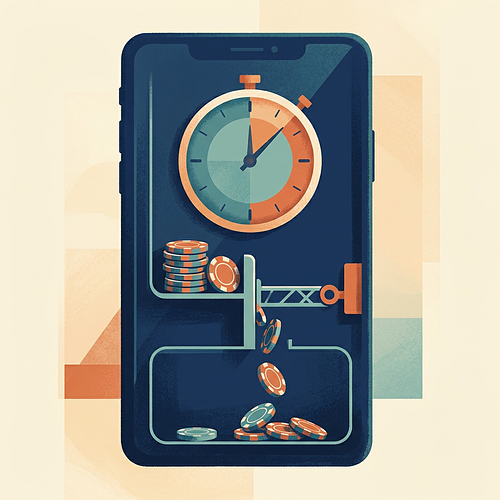
The UK Gambling Commission requires remote gambling systems to provide facilities allowing customers to choose the frequency of reality checks during relevant gaming sessions. These display the time elapsed since the session began, must be acknowledged before play continues and provide access to account history [7].
Financial limits are a separate mechanism. From 30 September 2026, remote gambling systems subject to the rules must offer gross deposit limits, including 24-hour, seven-day and monthly periods, and prevent further deposits once a chosen limit has been reached unless the relevant conditions for changing it are met [8].
Neither rule demonstrates that digital gambling inherently weakens financial awareness. Reality checks are primarily about time, while deposit limits control how much money can enter the gambling account. They don't recreate the experience of physically handing over cash before each individual bet.
But their existence highlights something important about digital environments: what is made salient can be designed.
A physical wallet doesn't need software to show that €20 has disappeared. A digital environment has many more choices about which information remains visible, which requires another click and which interrupts the user at the moment of a decision.
That makes the interface part of the experience of money itself.
Would You Bet It the Same Way If It Were Cash?
The evidence doesn't give us a clean experiment in which the same person places the same sequence of online bets once with a digital balance and once by physically handing over notes. So the title can't honestly be answered with a simple yes or no.
What we do know is more interesting.
Across decades of research, cashless payments have been associated with slightly higher spending than cash, although the effect is small, varies considerably and appears to have weakened over time [4]. Different electronic payment methods don't produce identical responses, and different generations may not experience the distinction in quite the same way [5]. We also know that making digital spending more salient can change behaviour without making the money physical again [6].
Online betting adds another layer because depositing and betting can happen at different moments. The money can leave your bank before the individual decisions about what to do with it begin.
None of that means a €20 digital bet stops being €20 in someone's mind. It means that the context surrounding that €20 can be different.
Cash had one unusual property that required no interface design at all. Spend it and what remained changed in front of you.
Digital money can show us considerably more than cash ever could: exact balances, histories, limits, notifications and every transaction we've made. But someone has to decide when those things appear.
Maybe that's the more interesting question hiding inside Would You Bet It the Same Way If It Were Cash?
Not whether digital money feels real.
What does the way money is presented make difficult to forget?
References
- UK Finance. (2024). UK Payment Statistics / UK payment trends for 2023. Cash represented 12% of UK payments in 2023, down from approximately 60% in 2008. Source
- Prelec, D., & Loewenstein, G. (1998). The Red and the Black: Mental Accounting of Savings and Debt. Marketing Science, 17(1), 4–28. Source
- Ceravolo, M. G., Fabri, M., Fattobene, L., Polonara, G., & Raggetti, G. (2019). Cash, Card or Smartphone: The Neural Correlates of Payment Methods. Frontiers in Neuroscience, 13, 1188. Source
- Schomburgk, L., Belli, A., & Hoffmann, A. O. I. (2024). Less cash, more splash? A meta-analysis on the cashless effect. Journal of Retailing, 100(3), 382–403. Source
- Broekhoff, M.-C., & van der Cruijsen, C. (2024). Paying in a blink of an eye: It hurts less, but you spend more. Journal of Economic Behavior & Organization, 221, 110–133. Source
- Huebner, J., Fleisch, E., & Ilic, A. (2020). Assisting mental accounting using smartphones: Increasing the salience of credit card transactions helps consumer reduce their spending. Computers in Human Behavior, 113, 106504. Source
- Gambling Commission. Remote Gambling and Software Technical Standards, RTS 13: Time requirements and reality checks. Source
- Gambling Commission. (2026). Definition of deposit limits in the Remote Gambling and Software Technical Standards: Consultation Response. RTS 12B requirements effective 30 September 2026. Source