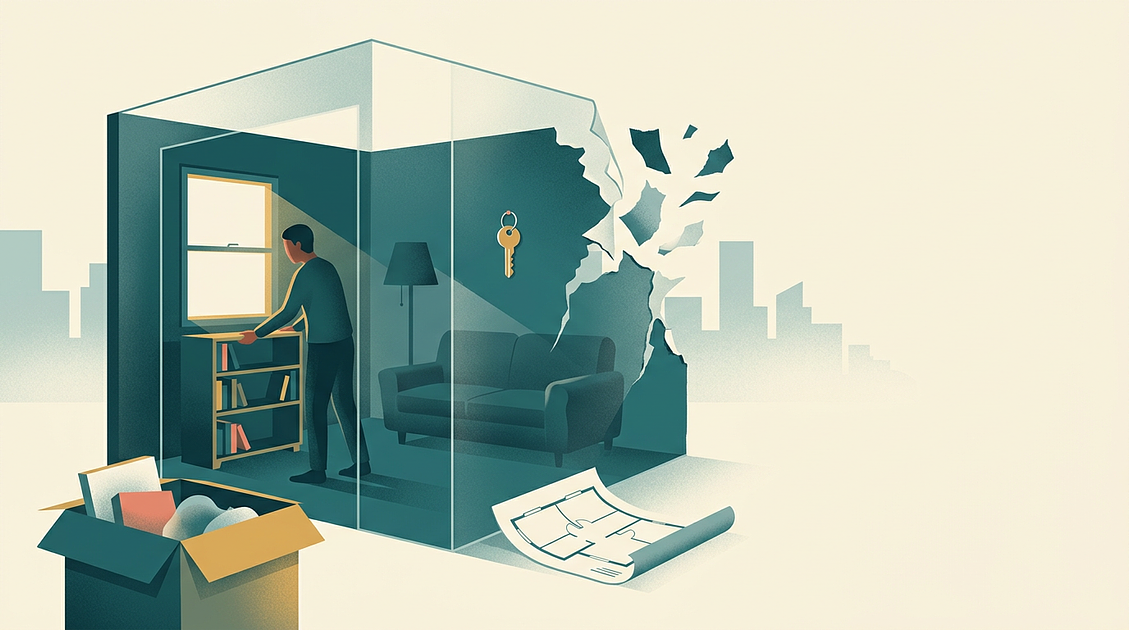
There's a feeling most people recognise but rarely name. You don't get something, a job, a flat, a place at a table you'd already mentally arranged yourself around, and the reaction lands heavier than you'd expect.
Not just disappointment. Something closer to loss.
Which is strange, because you never had it.
Maybe you'd already pictured the commute. Maybe you'd decided where the sofa would go. Maybe you'd caught yourself saying "when" instead of "if". Somewhere along the way, without anything actually becoming yours, your mind had started making room for it.
That's the interesting part. Not simply why losing things hurts, but the quieter moment before that, when something shifts from something I want to something I'm losing.

When "Mine" Starts Before You Own It
Think about seriously looking at a property you want.
You probably don't just look at the photos. You start checking whether your bookshelf would fit under that window. You calculate the commute. You notice the balcony gets afternoon sun. Maybe you look up the café around the corner.
By the time you close the tab, part of you has already moved in.
There is research suggesting that imagination alone can change how much something feels like ours. In a 2022 experiment, participants were shown objects they didn't own. Some were asked to imagine touching the objects, while others simply viewed them. The people who imagined the interaction later reported stronger feelings of psychological ownership towards those objects [1].
They hadn't touched them. They hadn't bought them. Nothing about actual ownership had changed.
They had just imagined the interaction.
Psychologists use psychological ownership to describe the subjective feeling that something is "mine", even when legal ownership isn't involved. Research by Pierce, Kostova and Dirks identified several ways this feeling can develop, including having control over something, becoming deeply familiar with it and investing part of ourselves in it [2].
Other research has found that imagining using or owning something can also induce feelings of psychological ownership before actual possession [3].
So the boundary may not sit exactly where the paperwork says it does.
Sometimes "mine" starts earlier.
Why Almost Getting Something Can Hurt More
You might assume that winning silver at the Olympics should feel better than winning bronze.
Objectively, it is a better result. Second beats third.
But psychologists Victoria Medvec, Scott Madey and Thomas Gilovich found something more complicated when they studied Olympic medalists [4].
They examined athletes' emotional reactions immediately after their events and later on the medal podium. Bronze medallists tended to appear more satisfied than silver medallists.
The researchers argued that the difference came partly from what each athlete was comparing reality with.
For someone who wins bronze, an obvious alternative is finishing fourth and leaving without a medal.
For someone who wins silver, the alternative sitting immediately above reality is gold.
The silver medallist achieved more, yet the version that almost happened was better.
That's counterfactual thinking: comparing reality with an alternative version of events that could have occurred.
It helps explain why proximity can do something strange to disappointment. Being nowhere near an outcome can make it easier to leave behind. Getting close enough to see exactly what might have happened gives the mind something much more vivid to compare reality against.
You don't experience only what happened.
Sometimes you experience the distance between what happened and what nearly did.

When Not Getting Something Starts to Feel Like Losing It
There's another piece of the puzzle.
Imagine being shown a coffee mug and deciding how much you'd pay for it.
Now imagine being given the mug first, keeping it for a while, and then being asked how much money you'd need before agreeing to give it up.
Same mug.
Would the number change?
Kahneman, Knetsch and Thaler tested something close to this by giving coffee mugs to some university students but not to others, then creating a market in which the owners could sell their mugs to participants who hadn't received one [5].
The mugs were the same. The only difference was that one group had been given a mug and the other hadn't.
When researchers asked what it would take for the owners to sell their mugs, they wanted substantially more money than the non-owners were willing to pay to buy the same thing [5].
Nothing about the mug had changed. Simply having one had changed what giving it up was worth.
This is part of the broader territory of the endowment effect, our tendency to value something differently once it belongs to us. It also fits with reference-dependent accounts of loss aversion, where the psychological impact of an outcome depends partly on the point from which we're evaluating it [6].
For the buyer, getting the mug would be a gain.
For the owner, giving it up is a loss.
Psychological ownership raises an interesting question one step earlier:
What if that reference point can begin shifting before the mug is ever handed to you?
Research by Shu and Peck found that psychological ownership and affective reactions can both help explain the endowment effect [7]. And the imagery research suggests that feelings of ownership don't always require actual possession in the first place [1][3].
That doesn't mean every disappointment is secretly a loss. You can desperately want something without ever feeling it was yours.
But there's a difference between I really hope I get this and I can already see this as part of my life.
The second one has something the first doesn't: a future that has already begun to feel familiar.
How Much of Yourself Did You Put Into It?
Ownership isn't the only way value can change.
Sometimes effort does it too.
Michael Norton, Daniel Mochon and Dan Ariely demonstrated this with IKEA boxes, origami and Lego [8]. In their experiments, participants assembled objects themselves and then placed a value on what they had made. The researchers compared those valuations with how other people valued equivalent creations they hadn't built.
The builders valued their own creations more.
The researchers called it the IKEA effect: putting labour into something can increase how much we value it.
This isn't the same as imagining that something already belongs to you, and the two shouldn't be collapsed into one mechanism.
What's interesting is what changes when we stop looking only at the outcome.
A half-finished novel isn't just a file on a laptop. It contains evenings you could have spent doing something else. A project you've spent months building isn't simply one possible project among many. A trip you've researched in ridiculous detail has already occupied hours of your life before you've boarded a plane.
The thing isn't necessarily yours.
But some of you is already in it.
That makes effort a strange kind of stake. Walking away can mean abandoning not only the hoped-for outcome, but also something we've already invested in trying to create it.
So What Did You Actually Lose?
This is where the original question becomes harder to answer than it first appears.
If you didn't get the flat, there was no property to lose.
If you finished second, the gold medal was never yours.
If a project never happened, its imagined future never became reality.
On paper, these are non-gains.
Psychologically, the boundary can be messier.
The evidence doesn't point to one mechanism that explains every case. Psychological ownership can make something feel like ours before possession [1][3]. Counterfactual thinking can make the alternative that almost happened unusually vivid [4]. Ownership can change the reference point from acquiring something to giving it up [5][6]. And effort can increase the value we place on things we've helped create [8].
Those aren't different names for the same effect.
They're different ways reality can end up competing with something our minds have already given weight to.
And perhaps that's why "you never had it anyway" can feel so unsatisfying when someone says it.
They're describing what existed in the world.
You're reacting, at least partly, to what had already started existing in your head.
That doesn't make every missed opportunity a genuine loss, or every imagined future something we secretly owned. It just means actual possession isn't the only thing capable of giving an outcome psychological weight.
Sometimes we imagined it vividly enough to make room for it.
Sometimes we came close enough to see the version that nearly happened.
Sometimes we invested enough of ourselves that walking away meant leaving some of that investment behind.
So when something you never had feels surprisingly difficult to lose, the better question might not be why does this hurt if it was never mine?
It might be:
What had already happened in my mind before reality said no?
The paperwork may never have said it was yours.
Your mind might have got there first.
References
- Iseki, S., Sasaki, K., & Kitagami, S. (2022). Development of a Japanese version of the Psychological Ownership Scale and the impact of product touch and imagined touch on psychological ownership. PeerJ, 10, e13063. https://doi.org/10.7717/peerj.13063
- Pierce, J. L., Kostova, T., & Dirks, K. T. (2003). The state of psychological ownership: Integrating and extending a century of research. Review of General Psychology, 7(1), 84–107. https://doi.org/10.1037/1089-2680.7.1.84
- Kamleitner, B., & Feuchtl, S. (2015). "As if it were mine": Imagery works by inducing psychological ownership. Journal of Marketing Theory and Practice, 23(2), 208–223. https://doi.org/10.1080/10696679.2015.1002337
- Medvec, V. H., Madey, S. F., & Gilovich, T. (1995). When less is more: Counterfactual thinking and satisfaction among Olympic medalists. Journal of Personality and Social Psychology, 69(4), 603–610. https://doi.org/10.1037/0022-3514.69.4.603
- Kahneman, D., Knetsch, J. L., & Thaler, R. H. (1990). Experimental tests of the endowment effect and the Coase theorem. Journal of Political Economy, 98(6), 1325–1348. https://doi.org/10.1086/261737
- Tversky, A., & Kahneman, D. (1991). Loss aversion in riskless choice: A reference-dependent model. Quarterly Journal of Economics, 106(4), 1039–1061. https://doi.org/10.2307/2937956
- Shu, S. B., & Peck, J. (2011). Psychological ownership and affective reaction: Emotional attachment process variables and the endowment effect. Journal of Consumer Psychology, 21(4), 439–452. https://doi.org/10.1016/j.jcps.2011.01.002
- Norton, M. I., Mochon, D., & Ariely, D. (2012). The IKEA effect: When labor leads to love. Journal of Consumer Psychology, 22(3), 453–460. https://doi.org/10.1016/j.jcps.2011.08.002